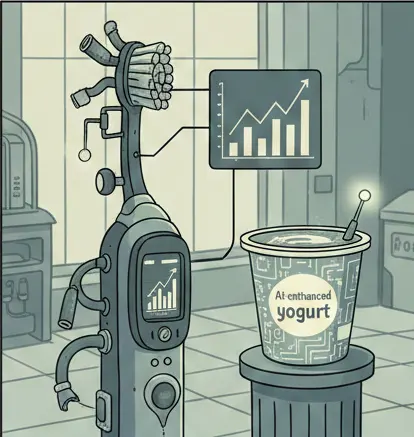
We are now firmly in the era where everything is “AI-powered”. Toothbrushes that are AI-powered for your “brushing performance”. Snack brands proudly announce “AI-enhanced yoghurt”. Someone, somewhere, is probably working on a “AI-smart potato” with an app.
The marketing departments are buzzing, the investors are delighted, and the rest of us are left wondering when the world collectively bumped its head.
Because for all this technological splendour, nothing actually works any better.
The Rise of Artificial Idiocy
You would imagine that something labelled “intelligent” might show a flicker of competence. Instead, AI features tend to behave like that one colleague who volunteers for tasks they absolutely cannot do.
“AI-driven cleaning mode!” it promises—before immediately getting stuck in a corner.
“Smart recommendations based on your habits!” it claims—while proudly suggesting something you have never once used, searched for, or shown the slightest interest in.
At this point, the only thing AI reliably detects is your rapidly declining patience.
Customer Support: A New Depth of Futility
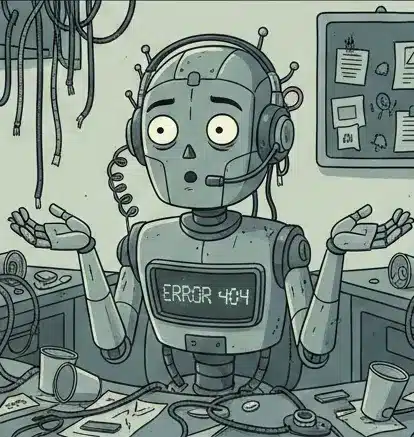
AI customer service bots have somehow achieved the impossible: they’ve made traditional customer support look efficient.
You ask a simple question. The bot thanks you for your question and responds with something unrelated. You ask again. It apologises brightly and repeats the same irrelevant answer, but with a different emoji.
Try to escape to a human, and the bot insists it’s “connecting you to an agent”, then quietly abandons you like it’s nipped out for a sandwich.
Eventually, you fix the problem yourself while the bot logs the interaction as a “successful resolution”.
Wordle: Five Letters, Infinite Humiliation
If you ever need reminding that AI is basically a very confident guesser with delusions of competence, ask it for help with Wordle.
You explain the rules.
It ignores them.
You say a letter definitely isn’t in the word.
It uses it immediately.
You give it every clue except the answer itself.
It proudly offers you a Victorian mineral you’ve never heard of.
It’s astonishing: a system trained on billions of words defeated by a puzzle solved daily by people half-awake with tea in hand.
Hallucination: The Feature That Refuses to Die
The trouble is not that AI occasionally gets things wrong — everyone does. The trouble is that it gets things wrong with the absolute confidence of someone who has never been challenged in their life.
Ask it for scientific citations, and it will conjure up references so convincing they look legitimate until you realise the journal doesn’t exist and the author never lived.
It is, in effect, a highly articulate bluffing poker player who has never once checked their cards.
When Humans Stop Thinking Altogether
This would all be fine — mildly irritating, occasionally funny — if people remembered to check what the machine says. But increasingly, they don’t.
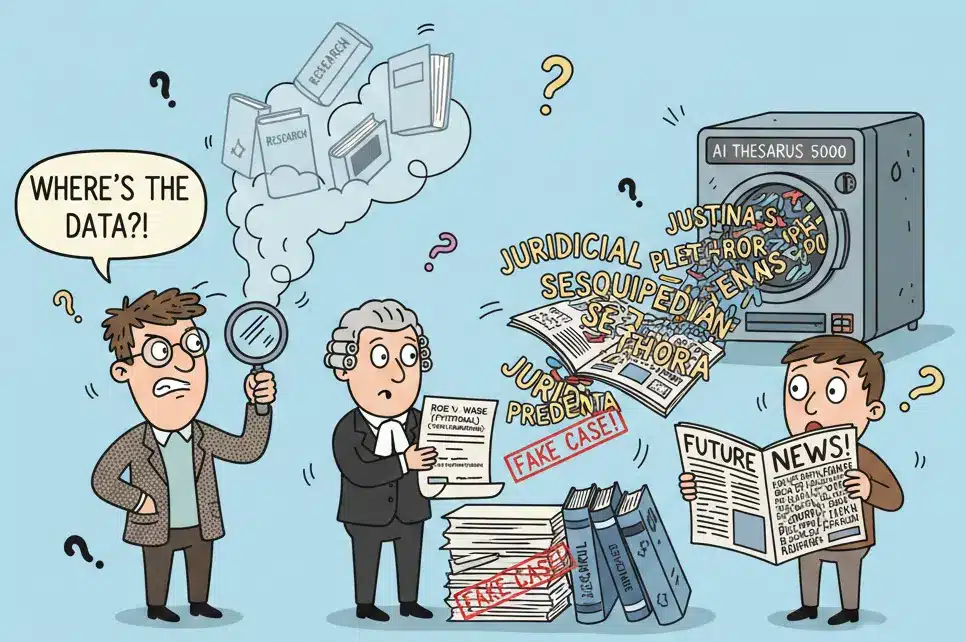
We’ve had academics citing research that evaporates when you try to find it. Lawyers submitting documents peppered with made-up cases. And magazines publishing AI-generated articles with such little oversight they read like someone plugged a thesaurus into a tumble dryer and printed whatever fell out.
And then there’s the cultural backdrop: a world where “Fake News” has been weaponised into a catch-all phrase for “anything I don’t like”.
Donald Trump uses it as a reflexive shield against anything that doesn’t flatter him. In that climate, dropping AI-generated nonsense into public life is like handing a megaphone to a foghorn.
AI Slop: The Internet’s New Grey Goo
The web is now stuffed with AI-generated tat: identical articles saying nothing, infinite motivational quotes recycled into oblivion, travel recommendations written by machines that have never seen a window, let alone a country. Recipes that forget half the ingredients. Images of people who don’t exist, eating food that doesn’t exist, photographed in rooms that don’t exist.
It’s a digital landfill — endless, bland, and quietly expanding.
The Real Issue: Common Sense Is Now a Collectable
The tragedy isn’t the AI itself — useful in the right hands, helpful in moderation, occasionally brilliant. The tragedy is that we’ve unleashed it into a world where far too many people treat machine-generated text as if it were a sacred manuscript delivered on a sunbeam.
AI requires human oversight, scepticism, and at least a teaspoon of judgement.
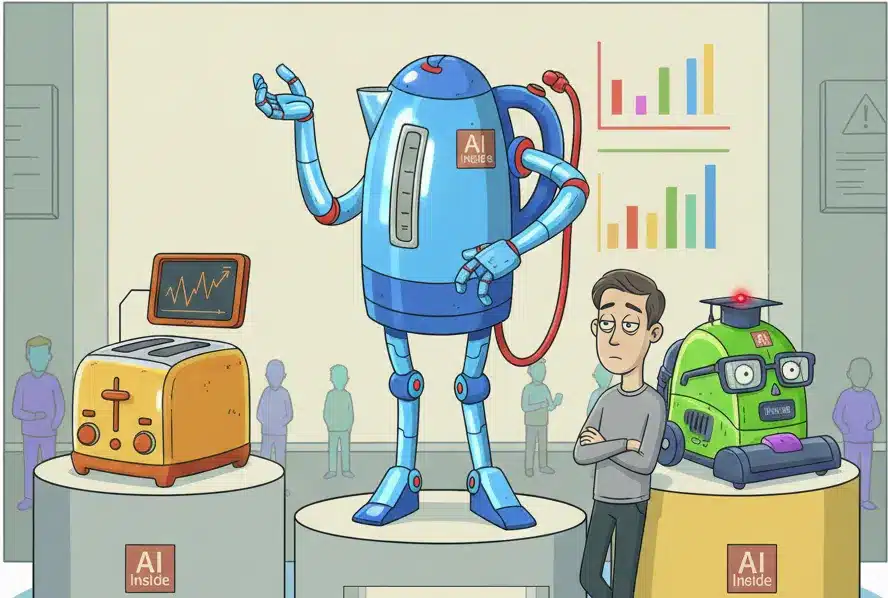
Sadly, common sense is now about as rare as a functioning smart kettle.
Closing Grumble
AI won’t destroy the world. People blindly trusting AI might.
It’s a powerful tool, not an oracle.
An assistant, not an authority.
A guesser with a decent poker face — not a thinker.
Use it wisely, question it constantly, and for heaven’s sake, stop buying AI-improved desserts. The yoghurt is fine.

